What they learn
In this stage, children pick up these strengths with their hands.
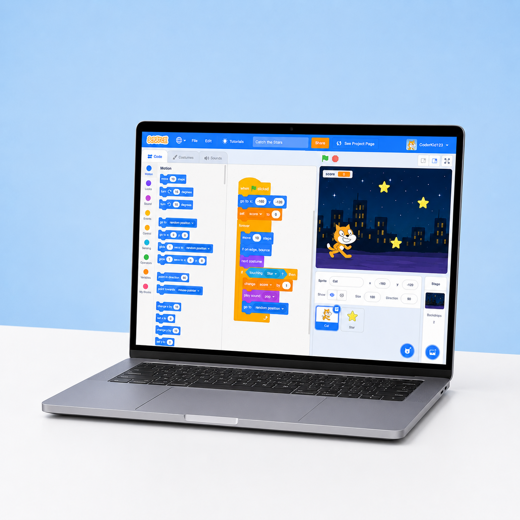
Design real games in Scratch — with scores, levels, and winning and losing.
Load code onto their own board and turn it into a controller or an invention.
Sense light, motion and temperature, and let boards talk to each other wirelessly.
Experience “training an AI on my own data” with Teachable Machine.
Eight terms, deepening step by step
Each term is 11 weeks — it ends in one finished project, and in the final week children present what they made at an English Demo Day.
Build a moving game world
Games with scores and outcomes
Build a controller with micro:bit
An arcade showcase
Inventions you carry around
Sensing the world with sensors
Music and stories made with code
A connected-system capstone
English at this stage
Immersion deepens at this stage. Designing games and coding their board all flows in English, and children start explaining what they made in full English sentences. Because it’s English used while making, it becomes their own far faster than textbook English.
How we handle AI
AI never writes the code for them. Instead, by “training a model on my own data,” children see for themselves how AI learns and gets things wrong. Privacy and digital citizenship begin here too — questions like “the camera sees the room — what’s okay to photograph?”
What they walk away with
An invention built on their own micro:bit, a playable game, and an end-of-term showcase presentation.
Class details
Shall your child start with MAKER?
Just tell us your child’s grade and interests and Adriana will personally say whether MAKER is the right fit and where to start.
Request a consult