What they learn
In this stage, children pick up these strengths with their hands.
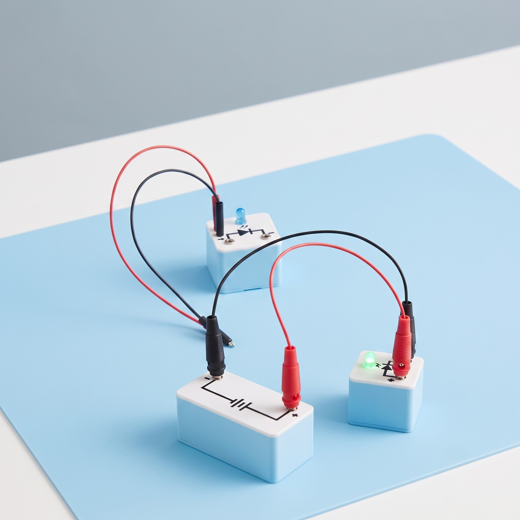
A cell, a switch and an LED, and a light that really comes on — and when it doesn’t, she finds the break and fixes it.
She puts picture blocks in order on a tablet, and learns that changing the order changes what happens.
Levers, pulleys and gears. One handle, and something lifts, turns or walks.
“It lights up!” — short, living English used while building, including saying what she changed.
Four courses, deepening step by step
A course runs six months — it ends in one finished build, and closes with a Demo Day where children introduce what they made to family in English. The first course assumes no experience at all.
A cell and a switch light it and ring it — and she finds the fault herself.
Picture blocks on a tablet move a character. She can start before she reads.
Levers, pulleys and gears — card becomes a machine that really works.
Circuits go inside a box: something that tells you, shown at the Invention Fair.
English at this stage
From day one, the language of the room is English. Children hear English instructions, respond with their hands, and speak living sentences like “It lights up!” while they build. English soaks in naturally with the joy of a circuit lighting up — English that begins with immersion.
How we handle AI
At this stage children don’t use AI — building things themselves comes first. Now and then the teacher simply shows that “AI gets it wrong too.”
What they walk away with
Every course, what she built comes home (a light-up card, a machine that moves), and the course closes with a Demo Day where she introduces her own build to family in English.
Class details
Shall your child start with SPARK?
Just tell us your child’s grade and interests and Adriana will personally say whether SPARK is the right fit and where to start.
Request a consult